Guide
Back exercises with no equipment
You do not need a gym to look after a sore back. You need a floor, a few minutes, and a routine that gets slightly harder over time.
Key takeaways
- A useful home routine covers mobility, core stability, and hip and back strength.
- Progress by moving to harder versions, not by adding endless reps.
- Sharp pain or pain spreading down a leg means stop that movement.
What does a home back routine need?
A useful back routine is not a random set of stretches. It covers three things:
- Mobility: moving your spine and hips through a comfortable range. Examples: cat-cow stretch, open-book rotation, and knees rocking side to side while lying on your back.
- Core stability: holding your trunk steady while your arms and legs move. Examples: bird dog, dead bug, and side plank from the knees.
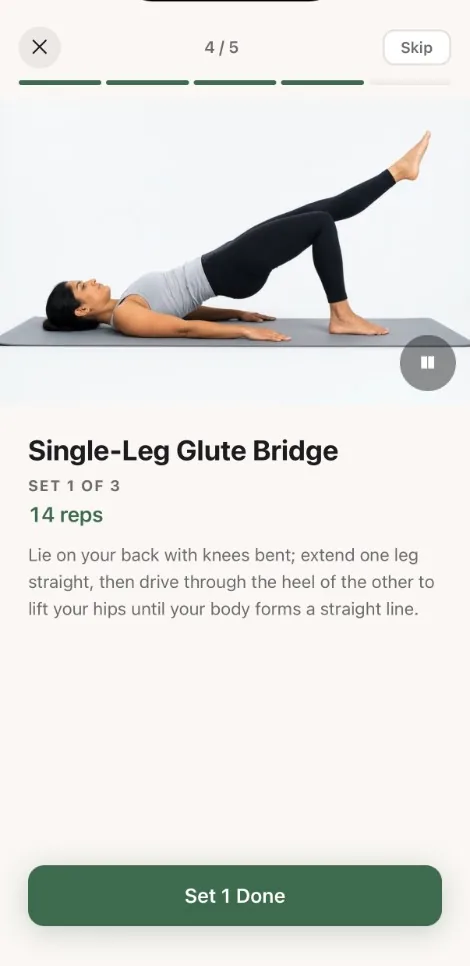
- Hip and back strength: the muscles that do the work when you lift, carry, and climb stairs. Examples: glute bridge, single-leg glute bridge, bodyweight squat, and split squat.
Guidelines like NICE’s recommend exercise programs for low back pain without naming one “best” exercise 1, and research comparing exercise types finds benefits across several 2. What matters more is doing a sensible mix regularly.
Progress by getting harder, not just longer
Doing thirty easy glute bridges is less useful than moving on to a harder version. A simple ladder looks like this: glute bridge, then single-leg bridge. For hinges, the hip hinge leads to the single-leg Romanian deadlift. For stability work, short holds of around eight to ten seconds, repeated, tend to work better than one long shaky hold.
Remedy works the same way: once an exercise reaches 15 reps, the program swaps in a harder variant instead of adding more. This is also why a routine needs weeks to show results; how long to stick with it covers what to expect.
Keeping it safe
- Move slowly and with control. Speed is not the goal.
- Mild, general discomfort that settles afterwards is common when you start. Sharp pain, or pain that spreads down a leg, is a reason to stop that movement.
- If an exercise always makes things worse, swap it for another in the same group.
Mornings are a good time for the mobility part if you wake up stiff. If your back trouble started in the gym, the gym guide covers how to train around it.
How Remedy fits
Remedy asks what equipment you have, and a floor-only program is fully supported. Every exercise has a demonstration video, and the program moves you up to harder variants over the weeks instead of piling on reps. How the program is built.
Exercises in this guide
Cat-cow stretch
An all-fours movement that alternates rounding and arching your spine.
Core and stabilityBird dog exercise
From your hands and knees, you reach one arm forward and the opposite leg back while keeping your back still.
Core and stabilityDead bug exercise
A core exercise done on your back: you slowly lower an opposite arm and leg while keeping your trunk still.
Glutes and hipsGlute bridge
Lying on your back with knees bent, you drive through your heels to lift your hips.
Glutes and hipsSingle-leg glute bridge
A glute bridge on one leg, with the other leg held straight.
Core and stabilitySide plank from the knees
A shorter-lever side plank with your knees on the floor.
StrengthBodyweight squat
A controlled squat with no load.
Questions
Can you strengthen your back without equipment?
Yes. Bodyweight exercises like the bird dog, glute bridge, single-leg bridge, side plank, and hip hinge build real strength when you progress them to harder versions over time.
How many times a week should I do a home back routine?
Three or more short sessions a week is a common target. Consistency over several weeks matters more than the length of any one session.
Sources
- Low back pain and sciatica in over 16s: assessment and management (NG59). National Institute for Health and Care Excellence, 2016, updated 2020.
- Owen PJ, et al. Which specific modes of exercise training are most effective for treating low back pain? Network meta-analysis. British Journal of Sports Medicine. 2020;54(21):1279-1287.
This guide is general fitness information, not medical advice. How we write our guides.