Guide
How long should you stick with a back routine?
Most people quit a back routine in the first week or two, right before it has had a chance to do anything. Here is a more realistic timeline.
Key takeaways
- Judge a back routine after four to six weeks of doing it regularly, not after a few sessions.
- Early progress is showing up consistently and the exercises getting easier.
- If your back is clearly getting worse over a couple of weeks, stop and get it checked.
Why the first week feels pointless
Strength and endurance build slowly. In the first week or two you are mostly learning the movements and getting used to doing them. Some people feel a bit better quickly just from moving more; many do not notice much yet. Both are normal.
Think in weeks
Structured back programs usually run over several weeks, with each week a little harder than the last. Clinical guidelines such as the NICE guideline 1 and the American College of Physicians guideline 2 recommend exercise for low back pain as an ongoing habit, not a one-off session, and the trials behind them typically run for weeks 3.
A useful way to think about it: judge a routine after four to six weeks of doing it regularly, not after four to six sessions.
What progress actually looks like
- You are showing up. Consistency is the first win, and the best predictor of the rest.
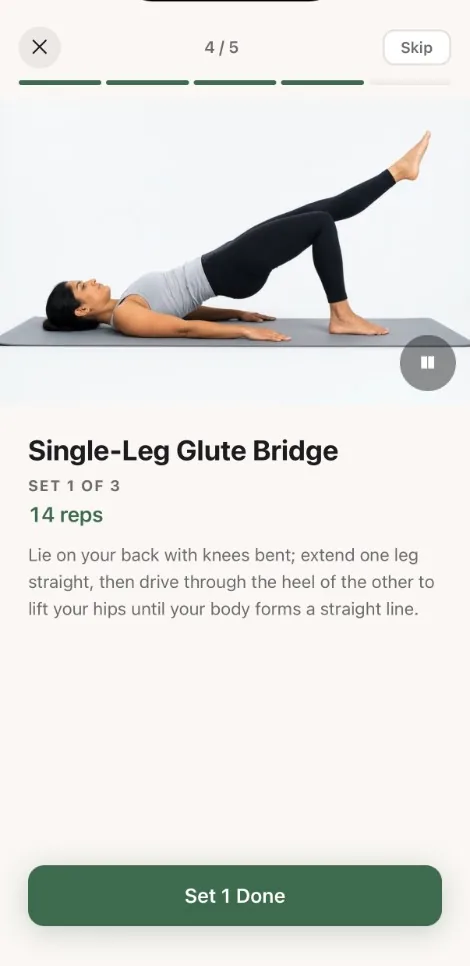
- The exercises get easier, so you move to harder versions. If you are training with no equipment, that might mean going from the glute bridge to the single-leg glute bridge.
- Everyday things bother you less: getting out of a chair, putting on shoes, a long drive.
- Bad days still happen. Progress is not a straight line. Look at the trend over weeks, not one morning.
For lifters coming back from a tweak, the same timeline applies to loading; the gym guide covers bringing weight back gradually. For desk workers, the hours of sitting count too; see the sitting guide.
When to change course
If your back is clearly getting worse over a couple of weeks of sensible exercise, or new symptoms show up, stop and get it checked. A routine is supposed to be challenging, not to make things steadily worse. When to see a doctor lists the warning signs.
How Remedy fits
Remedy sets your program length from how long your back has been bothering you, and runs it over several weeks with the difficulty rising as you go. Quick before-and-after check-ins on each session turn the “am I actually improving?” question into a trend you can see. When a program ends, you can build the next one from a short check-in, or level up your current plan. How it works.
Exercises in this guide
Glute bridge
Lying on your back with knees bent, you drive through your heels to lift your hips.
Glutes and hipsSingle-leg glute bridge
A glute bridge on one leg, with the other leg held straight.
Questions
How long does it take for back exercises to work?
Many structured programs run for several weeks. A useful rule is to judge a routine after four to six weeks of regular sessions.
Is it normal to feel no different after a week of back exercises?
Yes. In the first week or two you are mostly learning the movements. Some people feel better quickly from moving more; many don’t notice much yet.
Sources
- Low back pain and sciatica in over 16s: assessment and management (NG59). National Institute for Health and Care Excellence, 2016, updated 2020.
- Qaseem A, et al. Noninvasive treatments for acute, subacute, and chronic low back pain: a clinical practice guideline from the American College of Physicians. Annals of Internal Medicine. 2017;166(7):514-530.
- Hayden JA, et al. Exercise therapy for chronic low back pain. Cochrane Database of Systematic Reviews. 2021;CD009790.
This guide is general fitness information, not medical advice. How we write our guides.