Guide
Exercises for lower back pain: what actually helps
Exercise is one of the most recommended things you can do for a sore lower back. There is no single magic move. What works is a sensible mix, done regularly and made a little harder over time.
Key takeaways
- Clinical guidelines from the UK, US, and WHO all list exercise as a first-line option for low back pain.
- No single exercise is best. Several types help, and the one you will keep doing beats the perfect one you skip.
- A good routine covers mobility, core stability, and hip and back strength, and gets harder over the weeks.
Does exercise help lower back pain?
Yes, for most people. Low back pain is the leading cause of disability worldwide, and in most cases there is no single structural cause that a scan would find 1. That is part of why guidelines lean so heavily on exercise and staying active rather than on fixing one specific thing.
The UK’s NICE guideline recommends exercise programs for managing low back pain 2. The American College of Physicians recommends exercise, along with other non-drug options like yoga and tai chi, as a first step for chronic low back pain 3. The World Health Organization’s 2023 guideline also lists structured exercise programs among its recommended options 4.
A Cochrane review of 249 trials found that exercise probably reduces pain for people with chronic low back pain compared with no treatment or usual care 5. The average effect is moderate, not miraculous, which is a good reason to treat it as a habit you build over weeks rather than a one-off fix.
Which exercises are best?
A large network meta-analysis compared different exercise types for chronic low back pain. It found benefits across several, including Pilates, stability (motor control) training, resistance training, and aerobic exercise 6. In practice that means the label matters less than covering a few bases:
- Mobility. Moving the spine and hips through a comfortable range. Cat-cow stretch, open-book rotation, and a hip flexor stretch are common choices.
- Core stability. Holding the trunk steady while arms and legs move: the bird dog, dead bug, and side plank from the knees.
- Hip and back strength. The muscles that do the work when you lift and stand up: glute bridge, hip hinge, and bodyweight squat.
- General activity. Walking counts. Walking for back pain has its own guide.
A simple starter routine
This is the kind of session Remedy builds early in a program for someone with no equipment. It takes about 15 minutes. Move slowly and stay in a range that feels manageable.
- Cat-cow stretch: 2 sets of 10 slow reps to warm up.
- Bird dog: 3 sets of 5 per side, holding each for about 10 seconds.
- Dead bug: 3 sets of 10, lowering over about 3 seconds.
- Glute bridge: 3 sets of 12.
- Hip hinge: 3 sets of 12.
- Child’s pose for back pain: 2 holds of about 40 seconds to cool down.
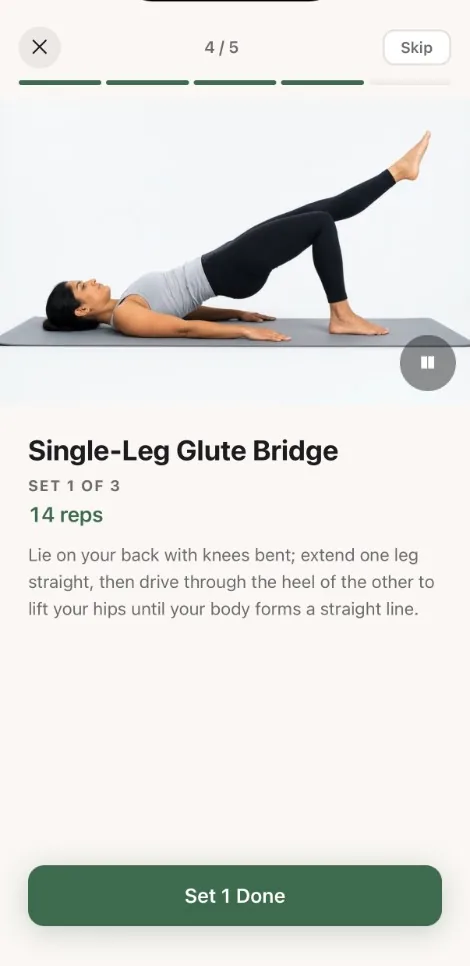
Do it three times a week. When a move feels easy for a full week, move to the harder version listed on its exercise page, for example from the glute bridge to the single-leg glute bridge. That is how Remedy progresses: harder variants, not endless extra reps.
What should I avoid?
You do not need to avoid bending or lifting forever. What helps is choosing a version you can do with control right now and building up from there. A few practical rules:
- Mild, general discomfort that settles within a day is common when you start. Sharp pain, or pain spreading down a leg, means stop that movement.
- Swap an exercise that always makes things worse for another in the same group.
- Don’t judge a routine after one week. How long to stick with it covers realistic timelines.
How Remedy fits
Remedy builds this kind of program from a short onboarding, including where it hurts and what makes it worse. Every session has a warm-up, main work, and cooldown, every exercise has a demonstration video, and the difficulty climbs week by week. See how it works or browse the exercise guides.
Exercises in this guide
Cat-cow stretch
An all-fours movement that alternates rounding and arching your spine.
Core and stabilityBird dog exercise
From your hands and knees, you reach one arm forward and the opposite leg back while keeping your back still.
Core and stabilityDead bug exercise
A core exercise done on your back: you slowly lower an opposite arm and leg while keeping your trunk still.
Glutes and hipsGlute bridge
Lying on your back with knees bent, you drive through your heels to lift your hips.
StrengthHip hinge
Bending forward by pushing your hips back while your spine stays long.
Stretches and recoveryChild’s pose for back pain
A resting stretch where you sit back toward your heels with your arms stretched out in front.
Questions
What is the best exercise for lower back pain?
There isn’t one. Research comparing different types of exercise finds benefits across several, including stability work, strength training, Pilates, and aerobic exercise. The best one is a sensible mix you will actually do a few times a week.
Should I exercise with lower back pain?
For most everyday back pain, yes. Guidelines recommend staying active and exercising rather than resting. Keep movements in a range that feels manageable, and stop anything that causes sharp pain or pain spreading down a leg. If you have any red-flag symptoms, see a clinician first.
How often should I do lower back exercises?
Most structured programs run three or more short sessions a week for several weeks. Consistency matters more than session length.
Sources
- Hartvigsen J, et al. What low back pain is and why we need to pay attention. The Lancet. 2018;391(10137):2356-2367.
- Low back pain and sciatica in over 16s: assessment and management (NG59). National Institute for Health and Care Excellence, 2016, updated 2020.
- Qaseem A, et al. Noninvasive treatments for acute, subacute, and chronic low back pain: a clinical practice guideline from the American College of Physicians. Annals of Internal Medicine. 2017;166(7):514-530.
- WHO guideline for non-surgical management of chronic primary low back pain in adults in primary and community care settings. World Health Organization, 2023.
- Hayden JA, et al. Exercise therapy for chronic low back pain. Cochrane Database of Systematic Reviews. 2021;CD009790.
- Owen PJ, et al. Which specific modes of exercise training are most effective for treating low back pain? Network meta-analysis. British Journal of Sports Medicine. 2020;54(21):1279-1287.
- Back pain (NHS Health A to Z). NHS, 2026.
This guide is general fitness information, not medical advice. How we write our guides.