Guide
Is walking good for back pain?
Walking is free, needs no equipment, and has some of the most encouraging recent evidence of any activity for people who keep getting back pain.
Key takeaways
- Staying active is better than bed rest for most back pain.
- In a 2024 trial, a progressive walking and education program roughly doubled the time people went before their next episode of low back pain.
- Build up gradually. Walking works well alongside a strength and mobility routine.
What the research says
The clearest recent evidence comes from the WalkBack trial, published in The Lancet in 2024. Adults who had recently recovered from an episode of low back pain were split into two groups. One followed an individualised, progressive walking program with education sessions. The other got no intervention. The walking group went a median of 208 days before their next episode, compared with 112 days for the control group 1.
That fits older evidence. A Cochrane review found people advised to stay active did slightly better than people advised to rest in bed 2, and a review of prevention studies found that exercise, alone or with education, lowered the risk of a new episode of back pain 3.
Why walking works
- It is gentle, rhythmic movement that most people can do even with a sore back.
- It is easy to make slightly harder over time by adding minutes or pace.
- It needs nothing but shoes, so it is easy to keep doing, which is what matters most.
How much to walk
The WalkBack program built people up gradually toward about 30 minutes, five times a week, with the plan adjusted to each person 1. A practical way to start:
- Walk for as long as feels manageable, even 10 minutes, at an easy pace.
- Add a few minutes each week, not each day.
- Once 30 minutes feels easy, pick up the pace or add a gentle hill.
The NHS has more general advice on walking for health 4.
Walking plus a routine
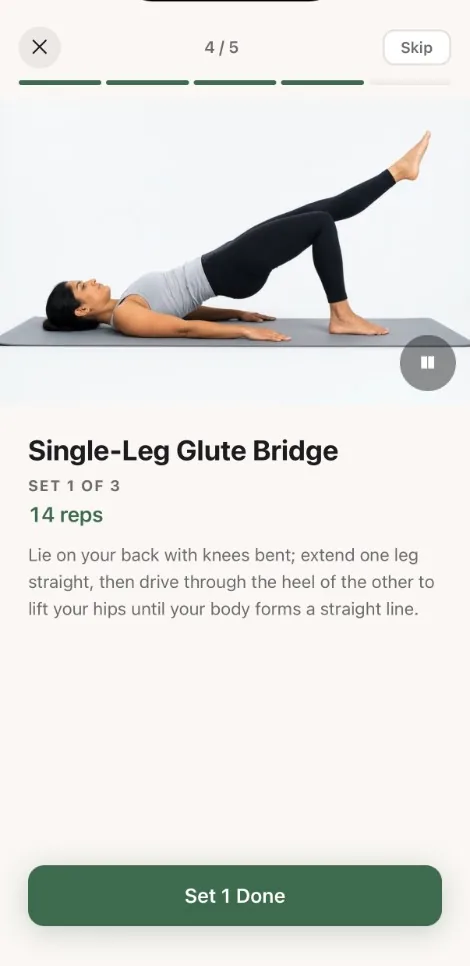
Walking covers general activity. It does less for hip strength, core stability, and mobility, which is where a short routine fits in. A glute bridge, a few cat-cow stretch reps, and a hip flexor stretch make a good partner for a daily walk. The lower back exercise guide has a full starter routine.
When to stop
Stop and get checked if walking brings on pain that spreads down a leg with numbness, tingling, or weakness, or if your back is getting steadily worse over a couple of weeks 5. See the warning signs guide for the full list.
How Remedy fits
Remedy is the routine half: short, video-guided sessions of mobility, stability, and strength on the days you choose. Walking is a great thing to do on the days in between. See how Remedy works.
Exercises in this guide
Cat-cow stretch
An all-fours movement that alternates rounding and arching your spine.
Glutes and hipsGlute bridge
Lying on your back with knees bent, you drive through your heels to lift your hips.
MobilityHip flexor stretch
A lunge-position stretch for the front of the hip.
Questions
How much should I walk for back pain?
Start with what feels manageable, even 10 minutes, and build up gradually over weeks. In the WalkBack trial, people worked up toward about 30 minutes, five times a week.
Is it better to walk or rest with a sore back?
For most everyday back pain, staying active is better. People advised to stay active do slightly better than those advised to rest in bed.
Can walking make back pain worse?
It can if you do far more than you are used to all at once. Increase time and pace gradually, and stop if pain spreads down a leg or you get numbness or weakness.
Sources
- Pocovi NC, et al. Effectiveness and cost-effectiveness of an individualised, progressive walking and education intervention for the prevention of low back pain recurrence in Australia (WalkBack): a randomised controlled trial. The Lancet. 2024;404(10448):134-144.
- Dahm KT, et al. Advice to rest in bed versus advice to stay active for acute low-back pain and sciatica. Cochrane Database of Systematic Reviews. 2010;CD007612.
- Steffens D, et al. Prevention of low back pain: a systematic review and meta-analysis. JAMA Internal Medicine. 2016;176(2):199-208.
- Walking for health. NHS, 2026.
- Back pain (NHS Health A to Z). NHS, 2026.
This guide is general fitness information, not medical advice. How we write our guides.